

How it all began
On that August summer day, I was doing my financial market research and organizing my Obsidian notes.
At one point I downloaded two CSV files, then deleted them through Windows Explorer and discovered that Obsidian was starting to slow down.
Moreover, not the entire application was slow. The editor worked great, as did the search. But when switching settings sections, an unpleasant delay appeared.
Spoiler
The article is not entirely about ordinary bug hunting.
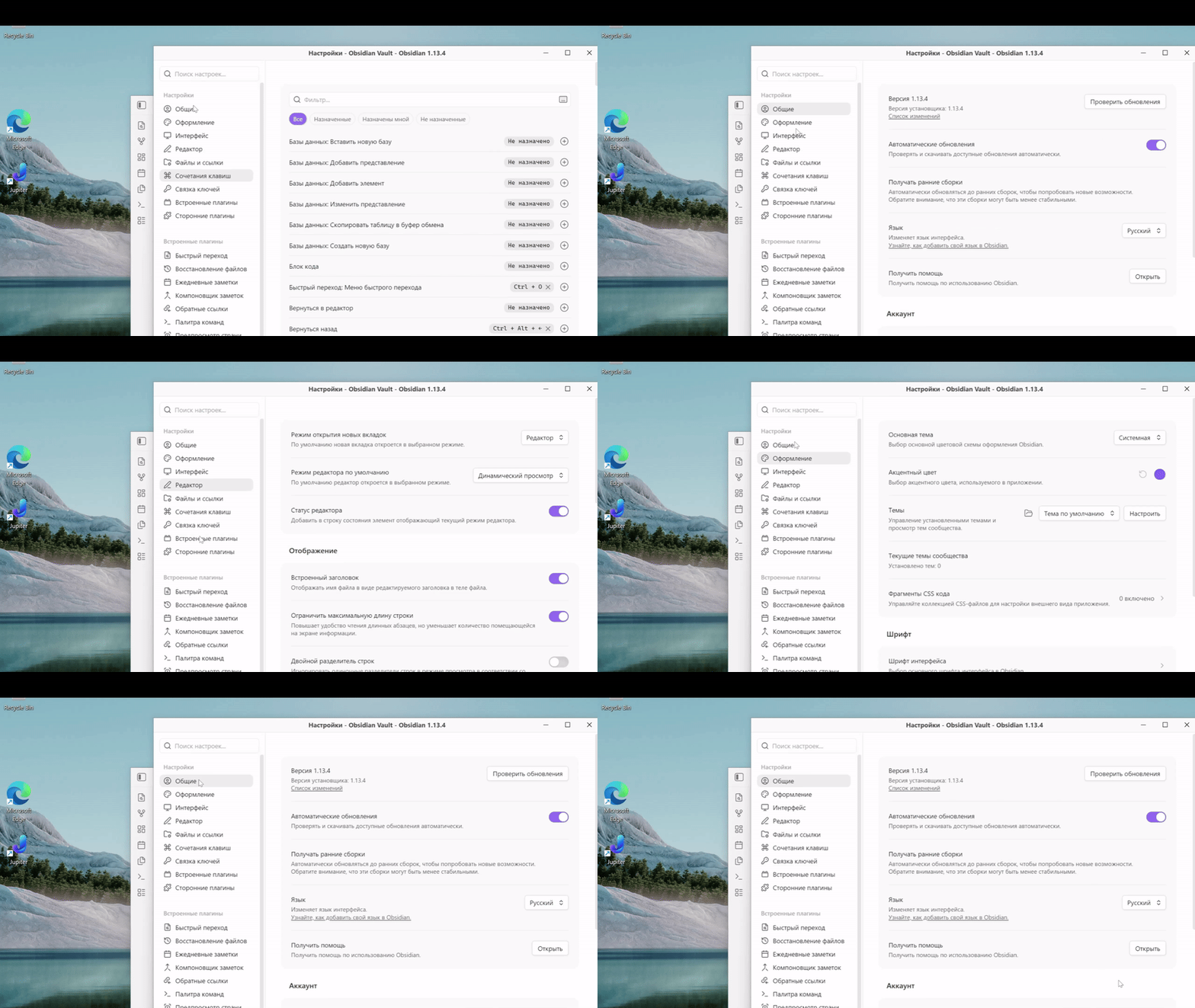
A trifle, of course. But you know, there are little things that don’t interfere with your life at all until you start paying attention to them. And after that it is no longer possible to live with them. Especially for a perfectionist like me. All functions should work! I won't rest until I find a solution to the problem. Even if it's someone else's program.
I decided to figure it out.
To save my neural calculations, I turned to others - ChatGPT.
Why should a person independently look for the cause of the problem if there is a system nearby that is trained on a huge amount of information and is capable of explaining almost everything?
There were many to blame. Only no one was to blame
The first is damaged storage. Created something new. It slows down. Then plugins. Disabled. It slows down. Theme, configuration, hardware acceleration, program installation.
With each new experiment, the range of possible causes seemed to narrow, but Obsidian continued to slow down.
I have already started sinning on my own computer. Maybe the problem is in Windows? Video driver? Electron? ChatGPT was not far behind. He put forward new hypotheses, explained how to test them, and analyzed the results.
And the most interesting thing is that almost every next hypothesis looked reasonable.
Well, really, why not check out one more setting? This will only take a couple of minutes. And then another one. And one more thing. So we quietly got to Chrome DevTools. This is where things got really serious. Instead, we should have asked the AI how many hours we have been digging and stopped. But not this time.
We opened Performance, started profiling the interface, and found that processing some interactions took about 300 milliseconds. At the same time, the individual stages of Recalculate Style and Layout took approximately 5–10 milliseconds.
Wow! Now we no longer had just brakes, but real measurements.
We discussed event processing, long-running tasks, and possible sources of latency.
For the first time, I felt like a person doing software performance research. Although recently I just wanted to open the settings.
And here something happened that we did not expect.
“Lo and behold, the settings are flying!”
At some point we decided to check out an older version of Obsidian. I downloaded 1.12.7.
Installed. Opened settings. And everything worked.
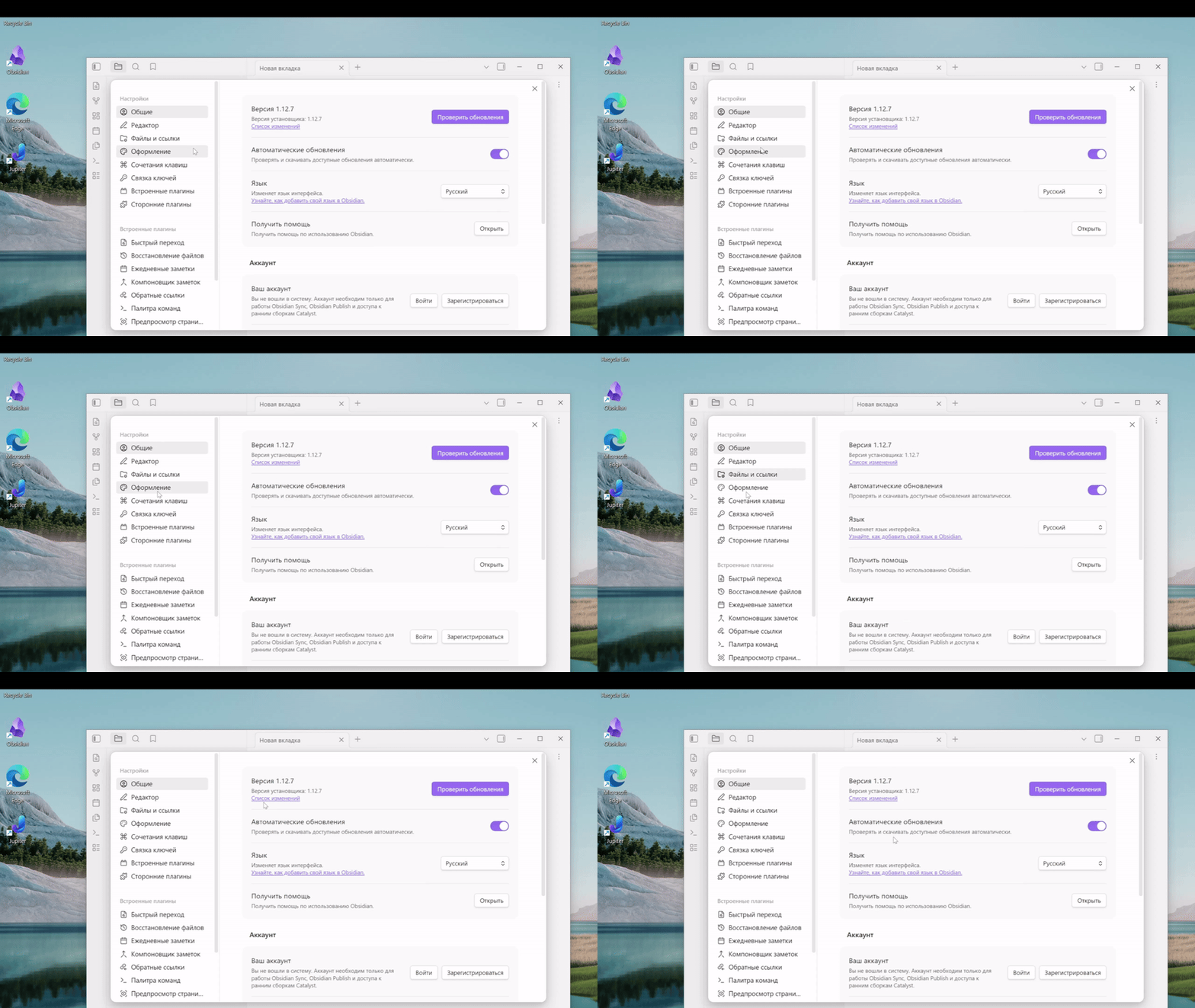
No delays. The interface responded completely normally.
Think about it. For several hours we checked the computer, settings, plugins, configuration, and studied the performance of the application.
And the practical solution was to install the old version.
On the same computer. With the same Windows.
I felt both joy from the solved problem and some bewilderment about the work done. However, by that time we were already so carried away that it would have been somehow strange to just stop.
After all, if two versions of the same application work differently, it already looks like a performance regression!
We continued our research.

And even here there were adventures. For example, it turned out that the old Obsidian installer did not always mean running the old version - the application could continue to download the updated package from the user directory.
Obsidian version: 1.13.4
Installer version: 1.12.7
I had to deal with this too.
We eventually confirmed the comparison: in 1.13.4, processing Settings switches took approximately 300–500 ms, and in 1.12.7 it took 30–60 ms.
After that, I published an official bug report.
Four days later I received a response from a member of the Obsidian team:
I can't reproduce. (Russian - I can’t play)
That is, there was a problem on my computer, we measured it, repeated it and fixed it with a rollback.
But the developers didn’t show it.
This could be the end of the story about the technical investigation. Moreover, we have not yet established the specific reason for the slowdown in the source code. Yes, we could dig further, but why?
For those interested in the details, here's the original bug report on the Obsidian forum. My other projects and research are collected in GitHub portfolio.
But something completely different interested me in this story.
Why did I even need these six hours?
Let's try to go back to the beginning. What was my task?
Don't explore Electron. No performance regression detected. Don't write a bug report for Obsidian developers.
I needed the program to work properly.
That's it.
To do this, it was enough to return to the previous version.
But somehow, in six hours, I managed to turn an ordinary user annoyance into a technical investigation.
And the most amazing thing is that no one forced me to do this.
ChatGPT didn't force me to open DevTools. Didn't require researching every hypothesis. Didn't insist on publishing a bug report. I asked questions. He answered. I checked. He suggested the next step.
And this process turned out to be so accessible that it was more difficult to stop than to continue.
But before everything was somewhat different.
Let's say I needed to understand Electron without ChatGPT.
First I would have to look for documentation. Then figure out how to open the developer tools, study the profiler interface, understand the metrics and try to understand what's going on.
At some point I would probably wonder: do I really need to know all this?
Maybe just reinstall the program? Or try the old version?
But now this natural barrier has disappeared.
Don't know how to open DevTools? Ask.
Don't understand the results? Ask.
Don't know how to test your next hypothesis? Ask.
Instead of several hours of self-studying the documentation - a few messages.
And suddenly it turns out that you are able to take on a task that you would not have even attempted before.
AI made complex actions so accessible that I stopped noticing how difficult the task itself was becoming
The superpower that can't stop
We are used to judging artificial intelligence by how much time it saves.
I wrote the code in a minute instead of an hour. Processed the document in seconds. Explained a complex concept without having to read multiple books.
All this really works. But there is one effect that I had hardly thought about before.
When you can do in a day what would previously have taken a week, this does not at all guarantee that you will have six free days. Maybe you'll just take on seven new tasks.
And then for fourteen. And each one will seem quite feasible.
Something similar happened to my Obsidian. One hypothesis was not confirmed? Okay, let's check the next one.
Found a delay? Let's measure. Got your measurements? I wonder what they are connected to.
Found the difference between the versions? We need to figure it out. Got it? Now you can write to the developers.
Each individual step is completely rational.
But if you look at the entire sequence, the question arises: are we even still doing the original task?
And there is an interesting contradiction here.
ChatGPT really helped me run my experiments faster.
But the experiments themselves might not have happened at all if I didn’t have ChatGPT.
It turns out that the tool simultaneously reduced the time it took to complete individual actions and increased the number of actions that I took on.
How much time did I save in total? Good question. And I don't have an answer to that.
But were those six hours wasted?
This is where I don’t want to jump to hasty conclusions.
Because in six hours we actually achieved something.
We tested several hypotheses, measured latencies, compared versions, discovered features of the update mechanism, and prepared a public technical report. (original bug report on the Obsidian forum)
I gained experience with tools that I had hardly used before.
We found strong evidence of performance regression.
And, what’s especially nice, all this turned out to be documented. The results can be shown to other people, discussed and attempted to be reproduced.
Is it useless? No. But then another question arises.
What exactly did I want to get when I started?
Working Obsidian? Or new research for your portfolio?
If the former, then we clearly did not choose the shortest path. If the latter, then six hours look completely different.
The problem is that I initially did not set the second task at all.
It appeared on its own while ChatGPT and I were dealing with the first one. And this is perhaps the most interesting discovery in the entire investigation.
AI doesn't just help me solve problems.
It makes it so easy to expand their boundaries that the original goal can be lost without notice.
Let's look into one more issue. Check out another idea. Do another experiment.
Everything is available. Everything is interesting. Everything is potentially useful. But this did not make my time endless.
So what now?
I still consider artificial intelligence to be one of the most useful tools I've ever had.
Without ChatGPT, I probably wouldn't be doing half the projects and research I'm doing now.
He really expanded my capabilities. But I used to have a natural limitation: I didn’t always know how to do something.
Now this barrier has become much lower.
And it turned out that along with new opportunities comes a new responsibility - to choose what to spend them on.
Perhaps the most useful thing I could do in early August was not open Chrome DevTools at all.
Just ask yourself one question:
Do I need Obsidian to work, or do I need to figure out why it's not working?
💬 Discussion 0
BBCode & Emoji supportedParticipate in discussions, ask authors questions, and share benchmarks by joining the ProArena engineering community.